Today is the publication day of our new Eagle Books title, Life and Breath, a wonderful collection of short stories for upper middle-grade readers by Ursula Dubosarsky, and we have a double reason to celebrate. Because not only are we delighted to be publishing this extraordiunary collection, but we are also thrilled to be publishing it simultaneously with Roffo Court Press in the UK!
Life and Breath features fourteen stories, collected in one volume for the very first time, with the addition of notes by Ursula on each story. The stories span a wide span of themes, in Ursula’s arrestingly distinctive voice and beautifully limpid prose. It’s an amazing book, and we hope it will find its way into the hands and hearts of many, many readers.
Warm congratulations to Ursula! Many thanks and appreciation to Jon Appleton and his team at Roffo Court Press, it’s been lovely working with you! And here’s to Life and Breath!
Christmas Press is delighted to announce that we have acquired world rights in The Secret of Panther Valley, a gripping mystery/adventure novel for middle-grade readers by talented author Brenton Cullen. The novel will be published in April/May 2027 under the Eagle Books imprint and was acquired via Debbie Golvan of Golvan Arts Management.
Christmas Press publishing director Sophie Masson said, ‘We are delighted to be publishing Brenton’s wonderfully pacy and intriguing novel, which richly conveys the atmosphere of the bush as well as being a fantastic adventure. With engaging characters, a deftly-woven mystery and a vividly-evoked setting, this is a novel that will have readers on the edge of their seats.’
While staying at his grandmother’s farm with his cousin Coby, mystery-loving 13-year-old Seamus learns the local legend of a panther stalking the region but his search for the truth turns to disaster when he finds himself alone, lost in a secret valley and hunted by a ruthless pair of men posing as documentary film-makers. He will need all his resolve, wits and courage to get out of the desperate situation he’s in, but in the process he uncovers a secret hidden for decades, and discovers a most unexpected and enigmatic ally…
Brenton Cullen explains the genesis of the novel: ‘The Secret of Panther Valley is an ode to the excitement of a country childhood and the secrets the Australian bush can hold. I grew up on farms that stretched for hundreds of acres, where I was always exploring the bush and creeks beyond our house and imagining adventures. I was fascinated by mysteries — especially the legend of the black panther said to roam the Blue Mountains. I often wondered what hidden creatures might be out there in the bush. When I was ten, I had a dream in which I was standing at our back door, watching in shock as a sleek panther crept past in front of me. That image has stayed with me. The Secret of Panther Valley grew from my adventures and that dream. I’m absolutely delighted that Eagle Books will be bringing this story to readers.’
Brenton Cullen is a fantastic new writer whose first middle-grade novel, The Prime Minister Problem, will be published by Riveted Press in April 2026. He has also written for magazines including Magpies and Books+Publishing, and was the recipient of the Ian Wilson Memorial Fellowship in 2023. We are delighted to welcome Brenton to the Eagle Books list!
There’s a fabulous advance review by Anneliese Gates in Books+Publishing of our forthcoming title, Ursula Dubosarsky’s wonderful collection of short stories, Life and Breath.
Here’s a short extract from the review:
By weaving together the everyday and the fantastical, the collection never falls into the predictable, and each short story leaves its own impression.
If you are a Books+Publishing subscriber, you can read the whole review here.
Life and Breath is out in March in Australia with Eagle Books, and simultaneously in the UK with Roffo Court Press.
Christmas Press is delighted to announce that we have acquired world rights in Only the Wild, a brilliant new novel for upper middle-grade/YA readers by multi-award-winning author Victor Kelleher. The novel will be published in September 2026 under the Eagle Books imprint and was acquired via Margaret Connolly of Margaret Connolly and Associates.
Christmas Press publishing director Sophie Masson said, ‘We are proud to have published three of Victor’s novels already, Wanderer (2022) The Cave (2024) and The Lastling (2025) and are thrilled to have acquired this extraordinary new novel from one of Australia’s greatest writers for children, whose brilliant work continues to enthral readers and to break new ground. In Only the Wild, Victor has created a reimagined future Antarctica, or ‘Great Southland’, where a vicious war is raging between fiercely determined clans of small farmers and a ferocious band of eco-warriors called the Wilders, whose aim is to eradicate all human presence in the Great Southland and return it to wilderness. Only the Wild is a brilliant mix of exciting adventure and thought-provoking themes, which raises many timely questions.’
An intriguing timeline introduces us to what brought history to this pass, and then the reader is plunged straight into the precarious world of Evan, son of a farming family, who dreams of finding a middle way between the warring factions, an unpopular idea on both sides which will lead him into great danger. After rescuing Emmy, a little girl who’s the sole survivor of an attack on a neighbouring family, he is confronted by a Wilder, a ruthless young woman named Reyne, and only just manages to escape with the child. But now Reyne is on his trail…and what happens next will set the scene for an extraordinary chain of events that will reach across time to change the fate of the Great Southland.
Victor Kelleher explains: ‘More than anything else, it was my long interest in the Rewilding movement that inspired me to write Only the Wild. In particular, I was drawn in by the ongoing debates. Should a rewilded area exclude humans? Or include them? If you’re going to argue the merits of re-introducing species such as wolves and bears and big cats, how can you in all conscience exclude us, the top predator? Ah, say the opponents of that view, humans are a special case: they’re the ones who destroyed wilderness in the first place. And so the arguments go on and on. Rather than join in, I set out to write a novel that embodied the very spirit of such disputes, imagining a future reforested Antarctica, completely free of ice, fought over by rival groups: farmers, and the Wilders. And then there’s Evan, who sees this great southland as his home, as long as he is prepared to live in tune with nature. This three-part struggle, and its resolution, is at the heart of the novel.’
We are delighted to present this great little trailer for Victor Kelleher’s brilliant new novel, The Lastling, which we are publishing in May. Hope you enjoy!
Christmas Press is delighted to announce that we have acquired world rights in The Lastling, a brilliant new science fiction novel for upper middle-grade readers by multi-award-winning author Victor Kelleher. The novel will be published in April 2025 under the Eagle Books imprint and was acquired via Margaret Connolly of Margaret Connolly and Associates. It follows the author’s Wanderer (2022) which was shortlisted for the 2023 NSW Premier’s Literary Awards, and The Cave(April 2024).
Christmas Press publishing director Sophie Masson said, ‘This is the third novel by Victor that we’ve had the pleasure of acquiring, and we are thrilled to be able to publish his extraordinary new book. With its Android and human protagonists, The Lastling is both an extraordinary adventure set in a disturbing future, and also a timely and thought-provoking exploration of what it really means to be human.’
Guido is an Android whose job it is to guide humans through the Wilderness Park, last remaining tract of unspoiled country, while Verne, a human girl, is a thief, working in the city. When Enforcers are dispatched to eliminate all the Androids, Guido, desperate to survive, does the forbidden thing and disobeys a direct order, triggering dire consequences. Years later, Verne, who knows nothing of Guido, is hired to break into the home of an old Enforcer and retrieve a mysterious weapon. It is then that her and Guido’s stories intersect. What happens next is as compelling as it is unexpected, setting both Verne and Guido on a path that reveals dangerous truths about the world they thought they knew, as well as forging a bond of trust between them, despite their differences.
As to what inspired the novel, Victor Kelleher said: ‘Artificial intelligence, robotics, and the whole notion of the android have been much in the news recently, and rightly so, in light of current technology. Yet underlying this interest is a much longer-standing issue: will AI be friendly to us, or will it threaten our human world? Many novels and films have offered an answer to this question. Some, like the film Terminator, give us two possible answers – AI as both friend and mortal enemy. So what does The Lastling add to this debate? At one level, like Terminator, it gives two answers, in the forbidding person of Brother John and the gentle figure of Guido. However, it also poses deeper questions. How does an android as gentle as Guido survive in the face of both AI and human aggression? How does he interact with someone as deeply human as Verne? And how does he out-think his own programming? Is such independence on his part even possible? And if so, is he, in some profound sense, also human? Now there’s a scary thought! And it’s that scary thought, more than any other, that inspired me to write this novel.’
Victor Kelleher(right) and Sophie Masson at the NSW Premier’s Literary Awards announcement event, 2023
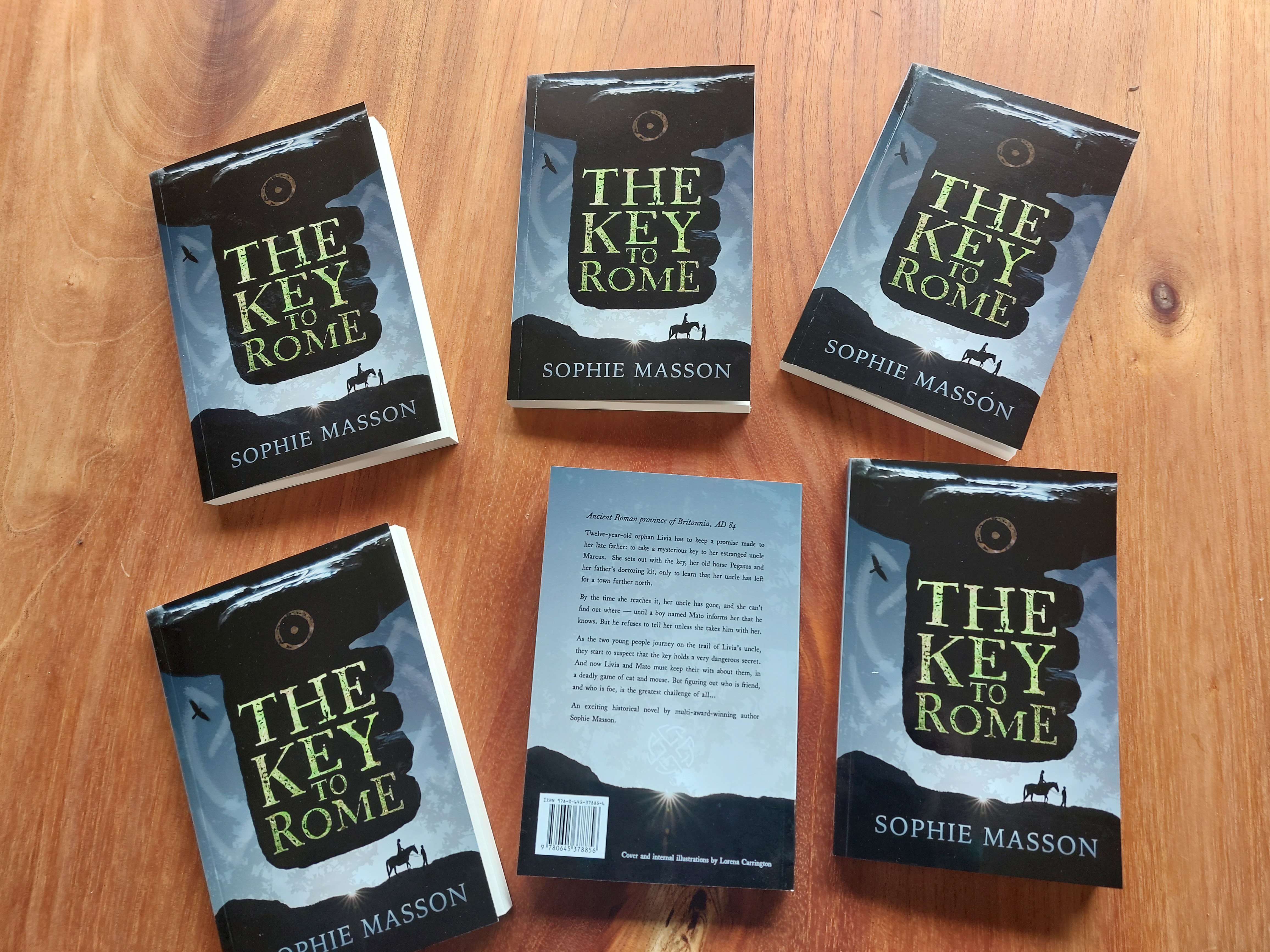
There’s a new, fabulous review for The Key to Rome on the popular Read Plus blog. Here’s a short extract:
Highly recommended. Sophie Masson is a master at weaving historical facts into captivating stories, and this book is no exception….The exciting plot moves along well, and readers are drawn into the dangerous game Livia is playing when she tries to figure out what the key means and why her uncle and his enemies will do anything to get or destroy it. But will they uncover the truth in time to stay alive? Detailed background notes and a glossary at the back of the book are very helpful additions for young readers.
We are delighted to reveal the striking, powerful cover of The Cave, Victor Kelleher’s forthcoming new middle-grade novel, which we will be publishing in April 2024. The cover is the work of the wonderful illustrator Lorena Carrington, who has also created several other beautiful covers for us, including Victor’s 2022 book, Wanderer, which was shortlisted for the 2023 NSW Premier’s Literary Awards.
Isn’t the cover gorgeous!
An exciting story set in a richly-recreated Paleolithic past, The Cave is both an extraordinary adventure and a moving exploration of loss, survival and courage. You can read more about the story here.
Here’s what Victor had to say about the genesis of the novel: ‘For almost as long as I can remember I’ve been fascinated by pre-history. In particular by the question of how our early ancestors, starting out as helpless wanderers on the plains of Africa, went on to become secure cave dwellers and greatly feared hunters. How did this great change come about? Clearly, the discovery of fire must have played a part. And so, too, the creation of better weapons and tools. But how did the change actually occur? That’s precisely the story I’ve tried to tell in The Cave. In order to do so, I’ve crammed many years of struggle and defeat into the short lives of one old woman and two young teenagers; and followed them through the seasons as they fight, not just to survive, but to turn the tables on the savage creatures that saw them only as prey. For me, there was something especially poignant about telling their story at this point in time, when we run the risk of destroying the very world they strove so hard to win.’
We’re delighted that Victor Kelleher’s Wanderer and Sophie Masson’s The Key to Rome have been featured in the newest edition of Kids’ Corner, a fabulous digital magazine from the NSW Branch of the Children’s Book Council of Australia. They’ve been included in a feature called Legends and Journeys, and come with some comments from Victor and Sophie.
You can read the whole issue here–the relevant pages are from 9-11, inclusive.




 Eagle Books